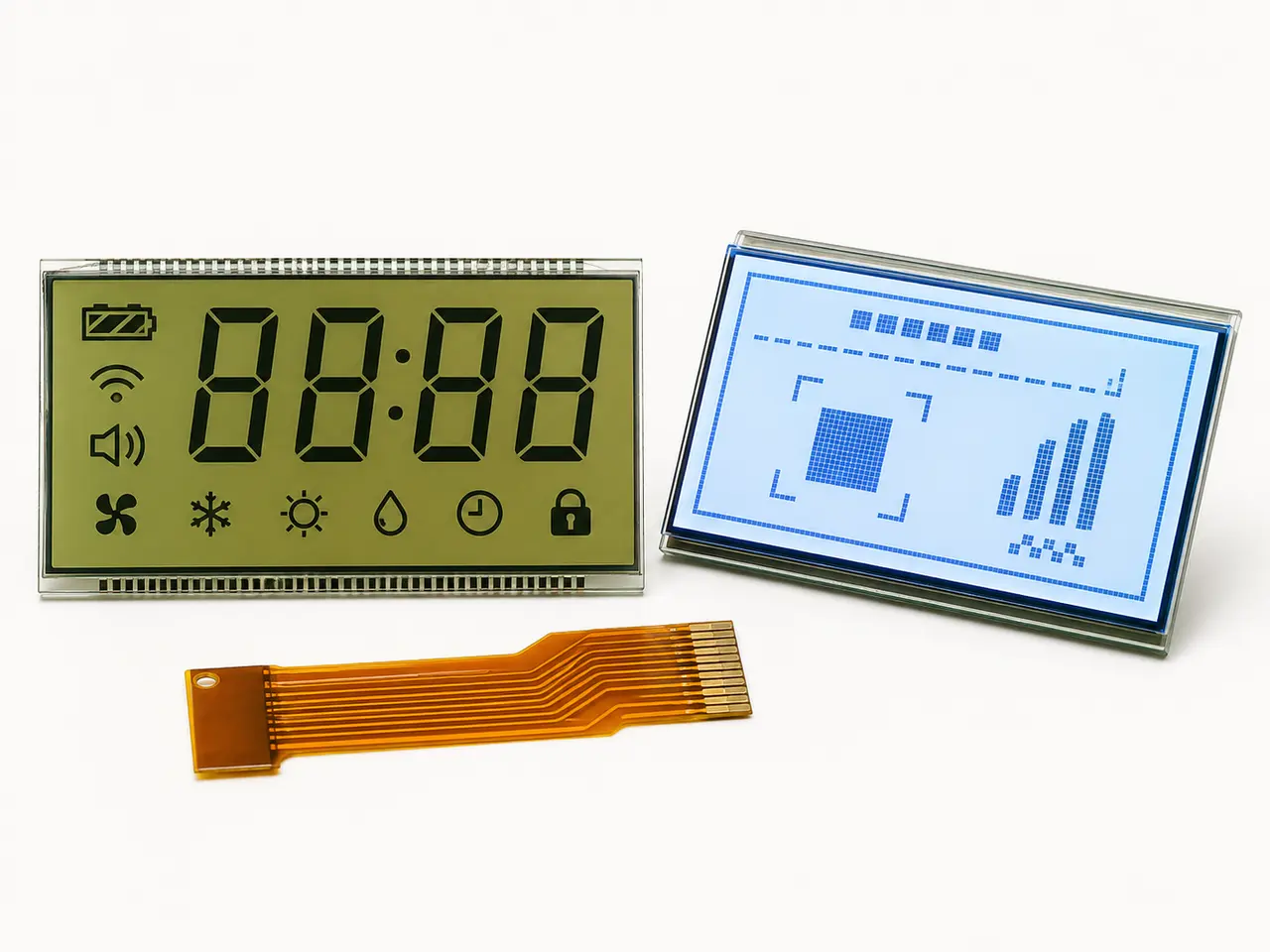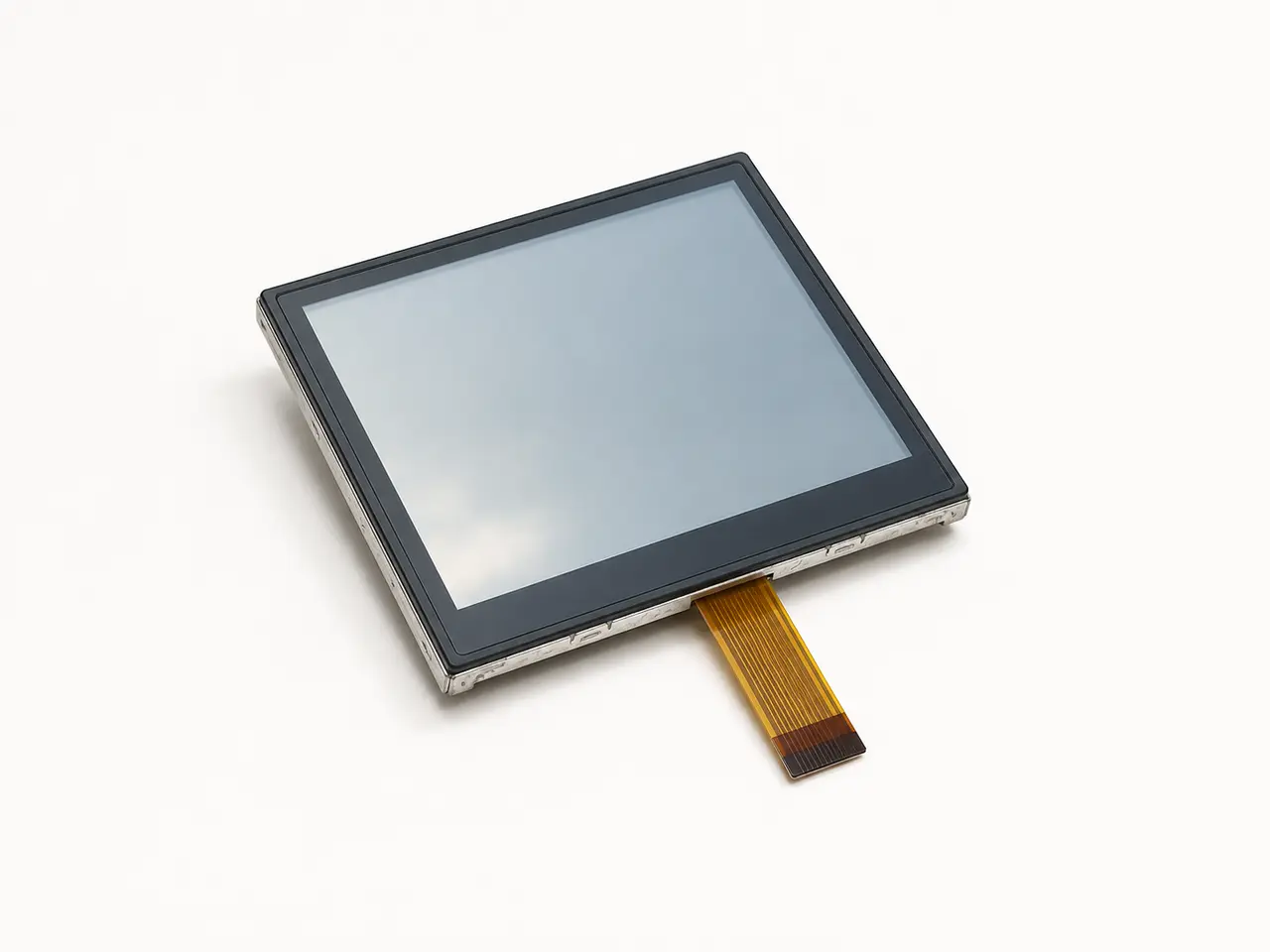
What reflective, transflective and transmissive mean
The terms describe how light reaches the viewer through the LCD optical stack. A reflective display returns ambient light through the front of the module. A transmissive display sends light from a backlight through the LCD. A transflective display uses a partially reflective layer so it can work with both ambient light and a backlight. This optical decision affects readability, power, thickness, color appearance and the backlight design.
- Reflective: ambient light is the primary light source.
- Transflective: ambient light and a backlight can both contribute.
- Transmissive: the backlight is the primary light source.
- The LCD fluid, polarizers, display mode and cover window still influence the final result.
Reflective LCD: strong daylight readability with low power
A reflective LCD becomes easier to see as useful ambient light increases because it does not need to overpower sunlight with a backlight. This makes it a practical option for battery meters, handheld instruments, simple outdoor equipment and products that must operate for long periods on limited energy. Reflective designs are most common in monochrome segment and graphic displays, where clear information matters more than full-color imagery.
- Best fit: bright environments, low duty-cycle products and long battery life.
- Main advantage: no continuous backlight power is required in normal ambient light.
- Main limitation: readability falls in darkness unless separate illumination is added.
- Typical use: meters, portable instruments, outdoor controls and simple status displays.
Transflective LCD: one display for mixed lighting
A transflective display is designed for products that move between bright daylight, indoor light and darkness. In strong ambient light, reflected light supports readability. In dim conditions, the backlight supplies the missing illumination. The tradeoff is that the partially reflective optical layer can reduce the efficiency of both light paths compared with a display optimized for only one path, so sample validation is important.
- Best fit: outdoor handheld devices, cycling equipment, marine controls and mobile industrial products.
- Main advantage: useful readability across a wider lighting range.
- Main limitation: optical efficiency and color appearance require careful balancing.
- Power can be managed by dimming or switching off the backlight when ambient light is sufficient.
Transmissive LCD: controlled backlighting and richer interfaces
A transmissive LCD depends on its backlight, giving the designer more control over brightness, color and visual consistency in indoor or shaded environments. This is the standard approach for many TFT modules and information-rich user interfaces. Outdoor performance is possible, but it typically requires adequate backlight luminance, good contrast, suitable optical bonding or coatings, thermal management and a realistic power budget.
- Best fit: color TFT interfaces, indoor equipment and high-information displays.
- Main advantage: predictable illuminated appearance and strong color capability.
- Main limitation: continuous backlight power and heat can become design constraints.
- Outdoor readability should be proven on the complete product, not inferred from backlight brightness alone.
Quick comparison for an OEM display project
Start with the environment rather than the display catalog. If the product is mainly viewed in bright ambient light and must minimize power, reflective is usually the first mode to evaluate. If it must work both outdoors and at night, transflective is often the stronger starting point. If the interface needs rich color or dense graphics and is usually backlit, transmissive is normally more suitable.
- Lowest typical backlight demand: reflective.
- Widest mixed-light operating concept: transflective.
- Strongest fit for full-color TFT content: transmissive.
- Every option still needs a defined viewing angle, contrast target and lighting test plan.
Sunlight readability depends on more than optical mode
Optical mode is only one part of outdoor readability. Front-surface reflections, cover-lens material, air gaps, polarizer selection, anti-glare treatment, contrast ratio, character size and viewing direction can change what the user actually sees. A high-brightness transmissive display can perform poorly behind a reflective cover lens, while a well-integrated monochrome display can remain clear with much less electrical power.
- Define the illuminance range and viewing distance for the real application.
- Review cover-lens glare, optical bonding and surface treatment with the complete stack.
- Check minimum contrast at the required viewing angles and temperatures.
- Test representative samples in sunlight, shade, indoor light and darkness.
What to include in the RFQ and sample validation plan
A useful LCD RFQ should describe how and where the product will be used, not just the glass size. The supplier can then review the optical mode with the electrical, mechanical and environmental requirements. Final approval should be based on a drawing, an agreed optical stack and product-level samples under representative conditions.
- Ambient lighting range, indoor or outdoor use and night-viewing requirement.
- Required color, content type, resolution, viewing area and viewing direction.
- Power source, permitted backlight current and thermal constraints.
- Operating and storage temperature, cover-lens details and expected annual quantity.
- Acceptance tests for readability, contrast, uniformity, color and backlight control.